
A Quick Recap
This lesson starts with a quick recap. In the last email you were introduced to the Model of Human Behavior. You learned that everyone is either outgoing/faster-paced or reserved/slower-paced. AND, they are also either task-oriented or people-oriented. It all looked like this:

If I didn’t emphasize it enough in the last lesson, I’m going to pause here and make sure I am clear and distinct. People are not all at the extreme ends of these two continuums. They will be all along the lines, leading some to be way out near the edges, while others are closer to the middle.
It's even possible that you know people who seem to be a balance of both. Sometimes they are more energetic and sometimes more reserved. You might also be aware of people who have a great ability to connect with people while at the same time focusing on the task to be done. Other people you know might well fit the definition of being out on the far ends of these continuums.
All of that is perfectly fine. Nobody has to be extremely outgoing, or significantly people-oriented. Perhaps you feel like you are a little bit reserved and only slightly task-oriented. Or maybe you think you are a just a smidge people oriented but extremely outgoing. You could be anywhere along these two continuums. To understand this better, let’s move on with the lesson.
In this lesson I am going to get into more detail about each of the four personality styles.
Key Concepts
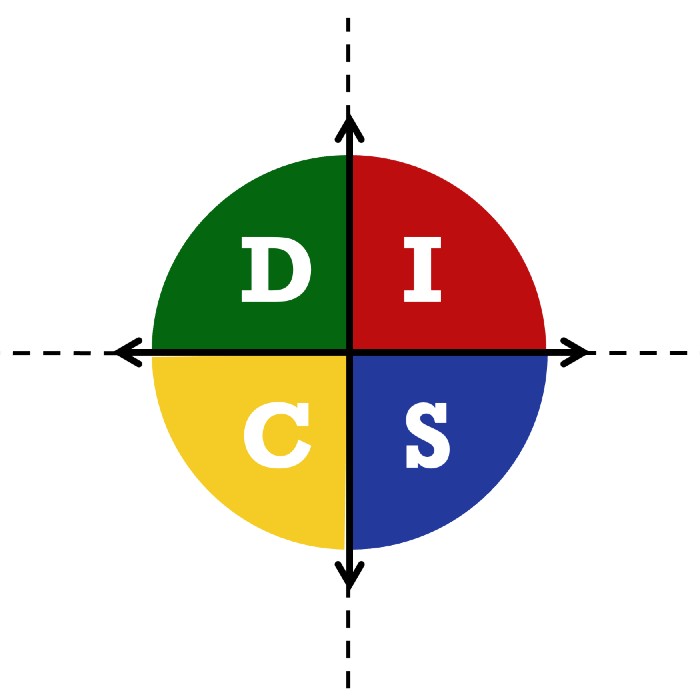
When you look at the Model of Human Behavior above you see 4 quadrants. Naming each one in a clockwise fashion they are:
- Upper Left: Outgoing/Faster-Paced & Task-Oriented
- Upper Right: Outgoing/Faster-Paced & People-Oriented
- Lower Right: Reserved/Slower-Paced & People-Oriented
- Lower Left: Reserved/Slower-Paced & Task-Oriented
You may recall that I mentioned William Marston, a Harvard Psychologist in the 1920s, was the first to label each of these four quadrants with the letters D - I - S - C, as shown in the graphic to the right.
This naming convention is the one that seems to have stuck and is used all over the world by many different practitioners, researchers, consultants, and coaches like me. This is where the name DISC Model of Human Behavior comes from.
Now, here comes the really cool part. Founded on centuries of research, but primarily based on Marston’s work, we have a better understanding of people’s behaviors, often referred to as their personality. Check out these details below.
D
People with a strong D-style, because of their tendency to be outgoing and faster-paced with a focus on tasks, are often: Direct, Driven, & Doers.
I
Individuals with a high I-style, because of they usually lean toward an outgoing and faster-paced motor with an emphasis on people, are often: Inspiring, Influencing, & Interactive.
S
Those who bring a lot of S-style, because of their natural inclination to be reserved and slower-paced with a focus on people, are often: Supportive, Steady, & Sensitive.
C
Others who have a dominant C-style, because they tend to operate as more reserved and slower-paced with a focus on tasks, are often: Cautious, Competent, & Careful
Put all of that together into the graphic showing above, and you get this visual showing below.
Remember those first two quiz questions?
- Are you more outgoing/faster-paced, or more reserved/slower-paced?
- Are you more task-oriented or more people-oriented?
In essence, I was inviting you to consider which of these 4 quadrants was likely to be the most dominant area for you. It would be the place from which you would naturally tend to live and lead your life.

As you think about the descriptive words I’ve shared with you above, which do you think best fit you? If you find yourself choosing words from more than one quadrant that’s GREAT! Because the reality is we are all a blend of all four quadrants.
A Real-Life Example
Earlier I told you how I better understood and could celebrate what other people brought into my life once I understood the DISC Model of Human Behavior. There were two things that happened to really open my eyes to all of this.
ONE: I completed the full DISC assessment. As I read my personalized results I saw that I am not just a person with a powerful C-style personality who lived deep down in the far bottom left quadrant of the model. I got a more complete picture of myself and saw that I also have a very strong inclination for supporting and caring for others. I realized how much more of a C and S style blend I bring to my personal life, as well as to my leadership, my management, and my interaction with people I have just met for the very first time.
TWO: I have had the opportunity to work with a lot of people who have completed the full DISC assessment, too. They learned about themselves just like I learned about me. They came to better understand themselves and what they brought to interactions they had with other people. Even more valuable was when we would share our DISC report results and learn more about each other, our natural styles for communicating, as well as our preferred way of approaching relationships and tasks. Our ability to work and interact effectively together dramatically improved as a result of us all understanding more about our personalities and using that knowledge to strengthen our relationships and make deeper connections.
Application To You
I mentioned before that we are all a blend of all four quadrants. So, take a moment and look over the descriptive words in each quadrant and pick out those words that most strongly apply to you.
You can choose all the words from any and all the quadrants that you want.